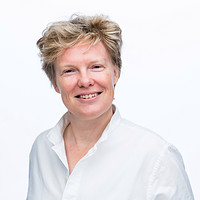
On 1 January 2026, Karin Verschoor traded her position as Head of the School of Commerce & Entrepreneurship (SCE) for a place on the Saxion Executive Board. In doing so, she succeeded interim board member Suzan Koning. How does Karin look back on her first days on the Board, in a completely new role at Saxion? “I now see Saxion from a completely different perspective, and I have to say: it’s humbling to see just how much of an impact our students and employees at Saxion have on the region.”
The plan was to take stock exactly 100 days after becoming a board member, but this just didn’t quite happen due to busy schedules. Despite this, we are now sitting at the table with Karin, not long after that 100-day milestone. To ask her how things have gone these past few months; what she has noticed, what made her enthusiastic and also what struck her most? And about the leader she aspires to be, at a time when Saxion is undergoing significant internal changes due to the restructuring of the organisation.
However, first things first: what word would Karin choose to describe how she feels after her first 100 days as a board member? “Can I use two, please? Then I’ll choose confidence and movement. I see an incredible number of enthusiastic employees and students with a wealth of talents and qualities. And here at Saxion, we are moving full steam ahead towards the next phase. That makes me proud of Saxion and excited about the position I have been given the opportunity to fulfil. It is wide-ranging and completely different from the work I used to do as Head of School. I now see Saxion from a completely different perspective, and I have to say: it’s humbling to see just how much of an impact our students and employees at Saxion have on the region. And internationally too. We don’t do this alone, but rather together with many partners with whom we form this ecosystem of knowledge and connections. What I used to see from one angle, as Head, I now see from a much broader perspective. I am deeply impressed by that.”
Guiding role
Karin says she really enjoyed talking to students. Here too, the word ‘pride’ feels appropriate, she says. “I recently read an article about students who set up a business to get their special spectacles on the market. Ones that make it easier to administer eye drops. Now that’s something I would call socially relevant. The discussions with student society chairpersons were also great, as were those with, for example, students on the archaeology study programme. I enjoy their enthusiasm and drive. Their new ideas. Many of our students are still at the start of their careers, of their adult lives. It is still quite special that we are able to play a guiding role at this stage, helping them chart their course. And that applies just as much to professionals in the field who are becoming students at Saxion for the first time, or returning to study. They, too, are on the move. They inspire us, and we contribute to their development.”
Energy
It perfectly captures the energy Karin felt when she first stepped into the Saxion Hall in Enschede back in 2001. The soft light, the buzz, the energy and pleasant atmosphere: Saxion felt like the place she wanted to end up after finding herself caught in a reorganisation at her former employer and had started looking for a new job. “I could have also chosen a different position, because I wasn’t at all sure whether education was really the right fit for me. But during the job interview, everything fell into place.”
A good next step
After holding positions as a lecturer, coordinator, team leader, manager and head, Karin says she carefully considered whether she wanted to take the step up to become an executive. That, too, was by no means a foregone conclusion. Yet taking a position elsewhere, outside Saxion, felt like abandoning the interesting and varied career path she had followed within the organisation. “In that sense, it was also a good next step. In particular to be able to look at Saxion from a completely different perspective and with new responsibilities. I have now been part of this organisation for 25 years and I would like to link up what is happening on the work floor with my executive duties. And we’d very much like to do so by remaining close and accessible to everyone who’s putting their shoulder to the wheel here.” Do issues and topics feel different now, from this new perspective? “Yes. I now feel a particularly strong sense of responsibility not only to identify and analyse problems, but also to provide managerial guidance on how to address them. And to weigh up the options: what needs to be done now, and what can wait until later?
Resilience
Looking at the organisation, Karin can see just how much resilience and loyalty the employees are showing during the current restructuring. “Change can cause uncertainty. This affects people personally. Nevertheless, I can see how many of my colleagues are willing to contribute ideas, take responsibility and ask critical questions. That last option is always welcome too. It is precisely in that openness that you can exchange ideas, understand one another better, weigh up the arguments and make progress together. The commitment that I used to see as head of my own school, I now see across the entire organisation. Our employees feel a strong sense of connection to their work, their colleagues and Saxion’s mission.”
The student as departure point
According to Karin, our university of applied sciences’ greatest strength lies in its broad range of education and research activities. And in everyone who is directly or indirectly committed to this cause, she adds. “The restructuring will enable us to condense our content more closely together. This is a tremendous opportunity to strengthen our core activities of education and research. This will further increase our impact in the region. That’s not about: ‘Look at how good we are,’ but rather what we can actually contribute to a thriving region. I also see this as my most important role on the Board. I want to help build a region where we educate students who will keep the region strong, vibrant and viable. A place where it’s nice to live and work. For example, also at our own university of applied sciences, as a good regional employer. As ultimately, that vital region comes back to benefit them. And all of us. This is why the student must remain our point of departure in the choices we make in our education and research. And that applies to how we structure our organisation as well.”

Biggest challenge
According to Karin, Saxion’s biggest challenge lies in daring to make choices in focusing its efforts. “We’re capable of a lot and we’re ambitious; we see potential everywhere. However, at the same time, we also face a financial and organisational challenge. We have to do our work with fewer staff and fewer resources. For fewer students as well. The challenge for Saxion is not to focus on optimising the way we always did it before. No, we need to take a fresh look at things and see how it can be done, or how it might be done differently. Not by scaling back our ambition, but by shaping it in a different way.” She explains that she is paying particular attention to the communication surrounding the restructuring. She is pleased to now and again hear that there is open communication. “But of course, this process always requires attention. I’m aware of the importance of this and am closely involved, particularly on a human level.”
Keeping an eye on the whole picture
After this initial period as Board member, does Karin see any differences between how employees and students view Saxion and how it is viewed from an executive perspective? “As an employee or student, you see the part you’re involved in. I, too, always used to look at things from the perspective of the lecturer, manager or head. Now I’ve stepped away from that line of thinking and I’m looking at things differently. In this new role, I need to keep an eye on the whole picture and, together with Inge Grimm and Richard Wielinga, help set our course.” But the new role certainly took some getting used to. That’s why every word can have a huge impact, she explains: “What I say now reaches further than before. And of course, it’s a different matter being head of a school yourself, whereas you now form an Executive Board as a trio. Of course, everyone has their own portfolio, but it’s also good to know you’re not on your own. You can bounce ideas off your colleagues, who have a similar overview of the situation. That is really nice."
Internationalisation as a source of inspiration
The word portfolio was just mentioned. It also touches on topics that Karin has come to know in a new and more in-depth way. She describes internationalisation as a valuable component, as the subject is directly linked to education. It also inspires her: “As far as I’m concerned, internationalisation isn’t just about mobility, but rather about seeing things from different perspectives. Learning to understand one another. Asking questions and wanting to listen and understand what others are saying. This is precisely what inspires me to maintain a broad view of the organisation as a whole, where so many different perspectives and areas of focus come into play. I now need to conclude management considerations in that regard. Without rigid frameworks, but rather by maintaining an open-minded approach. And internationalisation is also about ethics, developing a shared moral compass and safeguarding our democratic values. I believe that is crucial for education today and in the future. I want to emphasise this point even more strongly in the review of our educational philosophy.”
Greater focus
Over the past 25 years, Karin has seen Saxion change as an organisation. There has been an increasing degree of coherence not only in our education and research programmes, but also in our operational management. “Over the years, we have been able to formulate a single ambition across all the schools. Our part-time study programmes and interdisciplinary education are a fine example of this. Just like the key areas we have identified in our research. This is also what the current restructuring is all about: greater focus and decisiveness. Having the courage to make choices. In addition, there has been a strong focus on the transition from a family-oriented culture to a more professional one, without losing sight of the sense of mutual commitment and personal attention for one another. These can and have to be able to co-exist, alongside one another. However, I do think it is important that we start to harness all that individual knowledge and commitment more effectively for the greater good, rather than for our own field of study or organisational unit. That makes us stronger.”
Choosing quality
What does Karin hope to look back on with pride in a year’s time? “I hope we’ll have more peace of mind and clarity.” That, as an organisation, we are better equipped for the future, without losing sight of the human dimension. And also that students and employees feel that the choices we are making now are driven not only by financial and organisational considerations, but by Saxion’s ambition. That we prioritise the quality of the core processes of education and research.”
Conviction
She says it with conviction. In her new role, looking ahead. But also building on a journey she has undertaken in stages over the past 25 years. What is it that makes her still do this with such conviction? “That’s a feeling I’m still struggling to put into words. What drives me in life is the desire to make a difference for others. I believe that education is the perfect place to give free rein to that drive. Where you can provide everyone with opportunities and guidance in finding their place in society – to find your role. I often say to new employees: ‘Be careful, because education is addictive. You’ll get hooked on it.’ Especially when you start the year with all those fresh-faced, enthusiastic students and then, come summer, get to enjoy the graduation ceremony: the moment when students go on to pursue their careers in the professional field. It’s hard to explain what it is about that which moves me, but it’s there every single time.”
Photos: Thomas Busschers